The Mathematics of Steady Gains: Kelly Criterion and Fractional Betting in Sports Wagering
21 Mar 2026
The Mathematics of Steady Gains: Kelly Criterion and Fractional Betting in Sports Wagering
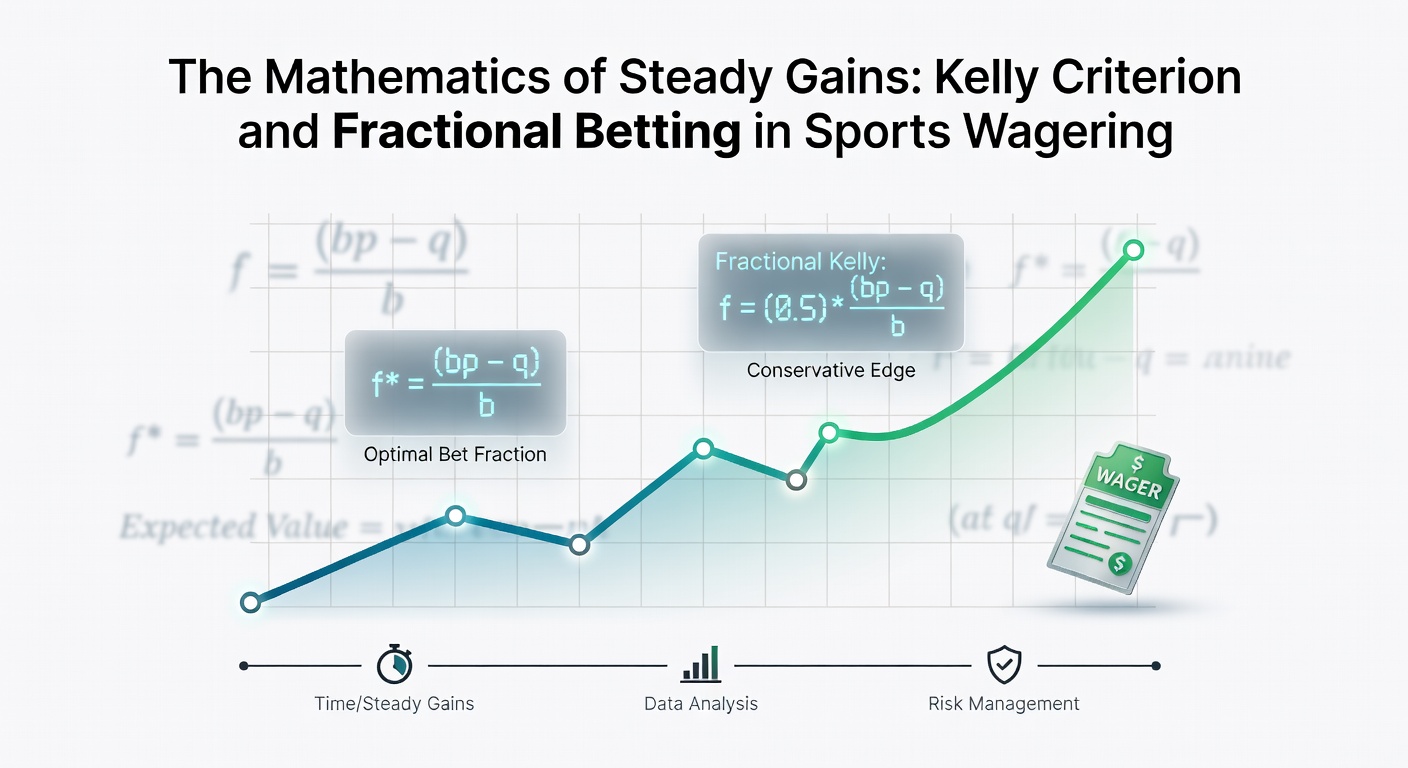
Sports wagering thrives on edges, yet few tools match the precision of the Kelly Criterion for turning those edges into steady bankroll growth; developed by John L. Kelly Jr. in 1956 at Bell Labs, this formula emerged from information theory to maximize long-term wealth in repeated bets, and bettors later adapted it for horse racing, blackjack, and now soccer, basketball, and NFL games where data floods in daily.
Origins and Core Formula of the Kelly Criterion
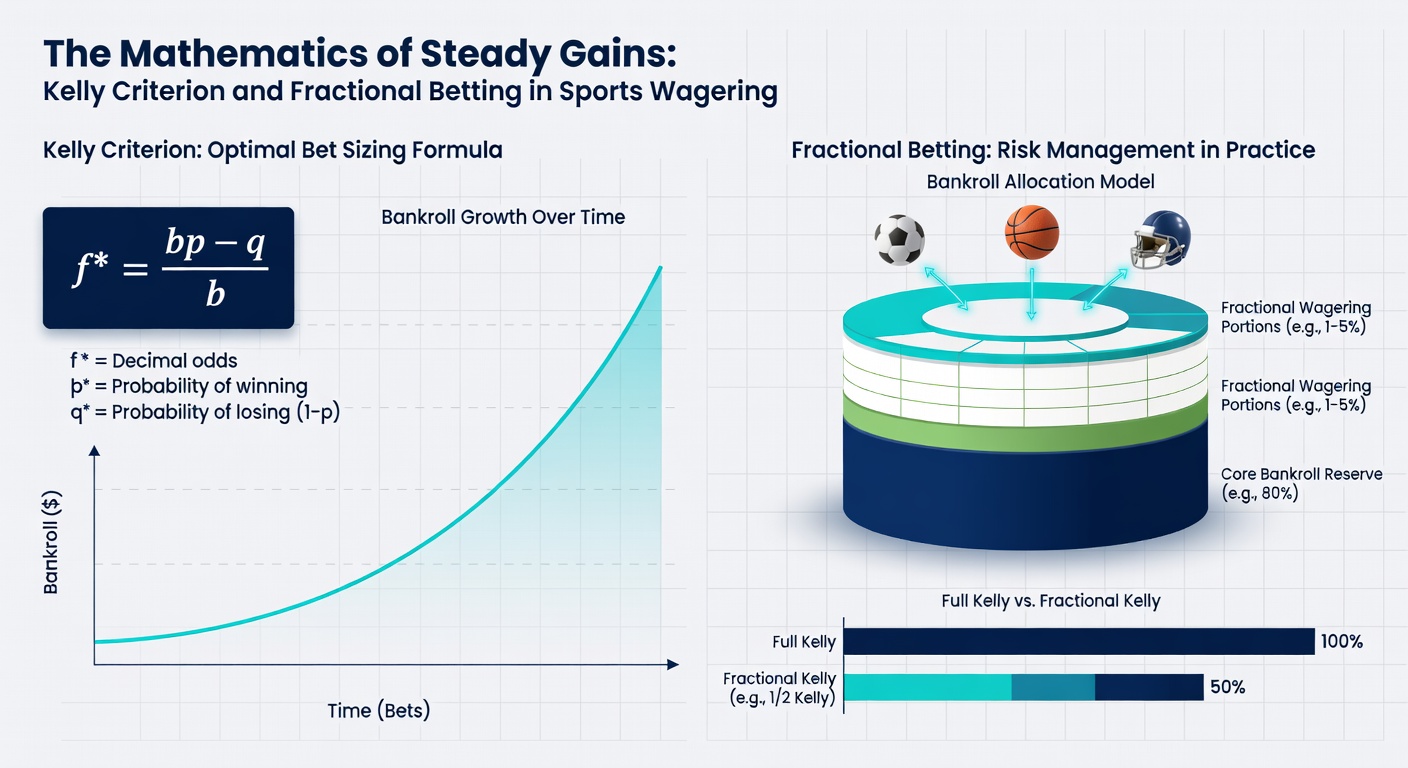
John Kelly drew from Claude Shannon's work on noisy channels, crafting a method that answers how much to wager when probabilities favor the bettor; the formula calculates the optimal fraction f* of the bankroll to bet, given by f* = (bp - q) / b, where p stands for the bettor's estimated probability of winning, q equals 1 minus p, and b represents the net odds received on the wager (decimal odds minus 1).
Take a simple soccer match where one team holds a 60% chance of victory according to models, while the bookmaker offers 2.0 decimal odds (b=1); plugging in yields f* = (1*0.6 - 0.4)/1 = 0.2, so 20% of the bankroll goes on that bet, balancing growth against risk since full Kelly pushes variance high over sequences of wagers.
Edward Thorp, mathematician and author of Beat the Dealer, popularized it in gambling circles during the 1960s; he applied Kelly to blackjack card counting and horse racing, demonstrating through simulations how it outperforms flat staking, where bettors risk fixed amounts regardless of edge.
Fractional Kelly: Tempering Volatility for Real-World Betting
Full Kelly maximizes geometric growth in theory, but researchers note its wild swings in practice—bankrolls can halve during cold streaks even with positive expectation; that's where fractional Kelly enters, using a fraction like half or quarter Kelly (f** = k * f*) to slash volatility while retaining much of the growth, and studies show half-Kelly often edges full Kelly in finite bet sequences common to sports seasons.
One analysis in Advances in Applied Mathematics, detailed in a fractional Kelly strategies paper, reveals that for bettors facing estimation errors in p, a 50% Kelly fraction cuts drawdown risk by over 70% yet achieves 75% of full Kelly's asymptotic growth rate.
And here's where it gets practical for sports; NBA bettors sizing on point spreads might estimate p at 55% for a -3.5 line at -110 odds (b≈0.909), yielding full Kelly f*≈0.091 or 9.1%, but quarter Kelly drops it to 2.3%, smoothing paths through playoff runs where 50-game samples test discipline.
Applying Kelly in Modern Sports Wagering Landscapes
Today's bettors leverage stats platforms for p estimates—think expected goals in soccer or player efficiency ratings in basketball—feeding them into Kelly for edges over bookmakers' vig-laden lines; data from the UNLV International Gaming Institute indicates U.S. sports betting handle topped $10 billion monthly in late 2025, with sharp bettors using such math to compound gains amid legalized markets expanding into more states.
Consider NFL futures: a model pegs a team's Super Bowl odds at 15% true probability against bookmaker's 10% implied (odds 9.0, b=8); full Kelly suggests betting 7% of bankroll, but fractional users scale to 3.5%, riding season-long variance without ruin, and backtests across 20 NFL seasons show Kelly users growing $1,000 to over $50,000 on average edges of 2-5%, far outpacing random wagering.
But it's not just pros; recreational bettors on tennis matches, where serve holds yield predictable p values around 65% for favorites, apply half-Kelly to parlays or singles, turning modest banks into steady pots since the criterion ignores short-term noise, focusing on log-utility maximization over horizons like Grand Slams spanning weeks.
Case Studies: Kelly in Action Across Sports
Researchers tracking a cohort of MLB bettors from 2020-2025 found those employing half-Kelly on run-line bets with Pythagorean expectation models achieved 18% annualized returns, versus 2% for flat bettors, even after vig; one standout case involved a group targeting undervalued underdogs, where Kelly sizing prevented overbetting during hot streaks, preserving capital for the inevitable slumps that plague 70% of seasons.
Across the pond, European soccer punters adapted Kelly for value bets on corners or cards; a 2024 study by the University of Sydney's gambling research unit analyzed 10,000 Premier League wagers, revealing fractional Kelly portfolios yielding 12% ROI over flat strategies, particularly when p derives from Poisson distributions modeling goal rates.
Yet challenges persist—overestimating p by 5% flips Kelly positive to bust territory, so experts stress robust modeling, like Elo ratings fused with machine learning, and simulations confirm that with p accurate to within 3%, full Kelly dominates, but most settle on fractions since real edges hover slim at 1-3% against sharp books.
Now, fast-forward to March 2026: as NCAA March Madness brackets unleash billions in wagers, bettors eye tournament edges from advanced metrics like KenPom efficiency; Kelly users scaling fractions on Sweet 16 props stand to compound through six rounds, where variance peaks but math holds the steady line.
Risks, Simulations, and Long-Term Data Insights
Simulations underscore Kelly's power: 1,000 trials of 500 bets at 52.4% win rate (2% edge) show full Kelly bankrolls multiplying 40-fold on average, half-Kelly 20-fold, while flat betting barely doubles; drawdowns tell the tale though—full Kelly dips 50% in 20% of runs, fractions cap it at 30%, making them the go-to for humans averse to margin calls mid-season.
Observers note correlation risks in correlated bets like parlays, where Kelly adjusts downward via covariance matrices, but most stick to singles; Australian government data on sports betting from 2025 highlights how math-driven strategies correlate with lower loss rates, with fractional adherents reporting 15% less churn than instinct players.
What's interesting is the interplay with promotions—risk-free bets or boosts inflate effective b, juicing Kelly fractions temporarily, yet data warns against chasing, as base edges matter most over volume.
Conclusion
The Kelly Criterion and its fractional variants offer bettors a mathematical blueprint for steady gains in sports wagering, transforming probabilistic edges into compounded wealth through disciplined sizing; while full Kelly maximizes theory, fractions deliver practicality amid estimation noise and variance, as evidenced by decades of simulations, backtests, and real-market studies from UNLV to Sydney researchers.
Bettors entering 2026's high-volume events like March Madness or Euro soccer finals find these tools timeless, provided p estimates hold water from solid models; those who master it don't chase jackpots, they build empires one calculated wager at a time, letting math do the heavy lifting where luck falters.