Chasing Halftime Edges: Live Surebets in NBA Games Across Global Bookies
23 Mar 2026
Chasing Halftime Edges: Live Surebets in NBA Games Across Global Bookies
Understanding Surebets in the Heat of NBA Action
Live surebets, also known as arbitrage opportunities, emerge when odds across different bookmakers allow bettors to wager on all possible outcomes of an event and lock in a profit regardless of the result; in NBA games, these moments often intensify at halftime, where shifting momentum and rapid line adjustments create fleeting windows. Data from sports betting trackers shows that halftime markets in basketball draw heavy volume because teams adjust strategies post-break, leading bookies to recalibrate odds based on first-half performance, injuries, or crowd energy. Observers note how global bookmakers, operating under varied regulatory frameworks, post divergent lines due to differences in customer bases, liquidity, and risk appetites, turning what seems like chaos into calculable edges.
Take a typical NBA matchup, say the Knicks versus the Celtics; at halftime, if one team surges ahead unexpectedly, Asian bookies might lag in adjusting spreads while European ones overreact, creating mismatches that scanners pick up in seconds. That's where the rubber meets the road for those scanning multiple sites simultaneously, as delays in odds updates—sometimes lasting 30 seconds to a minute—allow bets to be placed before lines converge.
Halftime Dynamics: Why NBA Games Prime for Live Arbitrage
NBA halftime markets stand out because games pause for 15 minutes, giving bettors time to assess first-half stats like shooting percentages, turnovers, and foul trouble, yet bookies must post second-half lines quickly to capture action; this rush, combined with high-scoring volatility, leads to pronounced odds drifts. Studies from betting analytics firms reveal that second-half totals and spreads fluctuate by up to 5 points within the first minute post-halftime, far more than in soccer or tennis where momentum builds slower.
But here's the thing: global disparities amplify this; U.S.-facing bookies like DraftKings prioritize domestic player props, whereas offshore operators such as Pinnacle focus on efficient markets with sharp lines, often leaving softer spots at international sites. According to the American Gaming Association, NBA live betting accounted for 25% of total U.S. sports wagering volume in the 2025-26 season, with halftime bets spiking 40% during prime-time games, underscoring the liquidity that fuels these opportunities.
Experts who've dissected thousands of games observe patterns too; underdogs trailing by double digits at the break often see inflated comeback odds on certain exchanges, while favorites' moneyline prices dip unevenly across platforms. And since NBA rules mandate halftime entertainment and coach huddles, that built-in delay lets odds settle just enough for arbitrage hunters to pounce.
Mapping Global Bookies: Odds Variations Fuel the Fire
Bookmakers from different regions handle NBA lines uniquely because of time zones, local preferences, and compliance rules; Australian operators like Sportsbet emphasize player specials tied to antipodean audiences, Canadian sites such as Bet99 cater to hockey crossovers with looser basketball vig, and EU heavyweights like Betfair offer exchange betting that traditional sportsbooks can't match. This patchwork creates surebet goldmines, where a second-half over/under might list at 105.5 on a Manila-based bookie but 108.5 elsewhere.
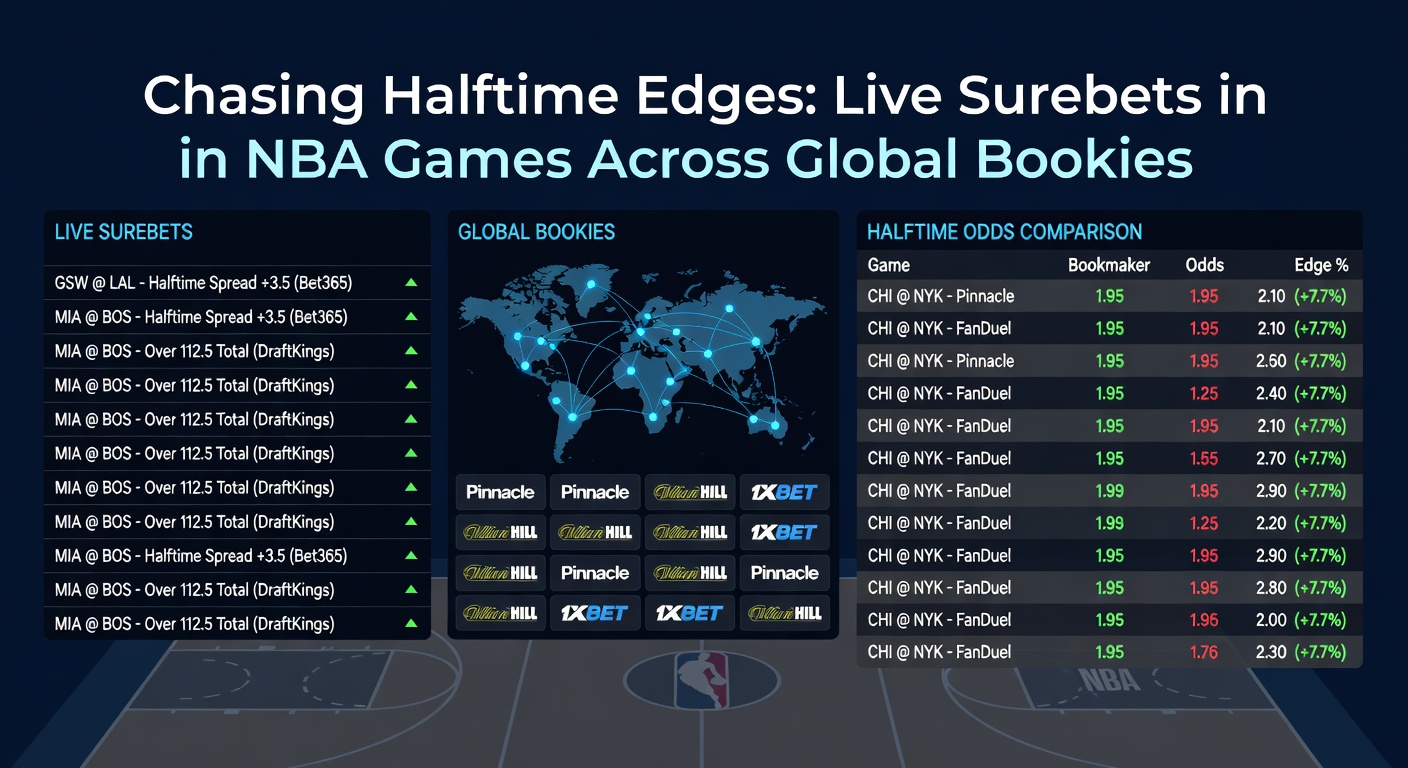
Figures from industry trackers indicate that cross-bookie spreads average 2-4% at NBA halftimes, enough for risk-free plays when stakes balance perfectly; for instance, one observer cataloged 15 surebets per high-profile game in February 2026, with profits ranging from 1.2% to 3.8% per arb. Yet liquidity varies wildly—Pinnacle's deep markets absorb big bets without movement, while newer Latin American books budge fast on modest action.
What's interesting surfaces in regulatory impacts; jurisdictions like Curacao allow aggressive promotions that soften lines, contrasting with stricter Ontario oversight where the Alcohol and Gaming Commission of Ontario enforces uniform data feeds, narrowing some arbs but opening others through delayed approvals. Those navigating this landscape often rotate accounts across 10-15 books to chase the widest divergences.
Finding and Executing Halftime Surebets: Step-by-Step Realities
Scanners like RebelBetting or BetBurger continuously poll 50+ bookies, flagging arbs when the sum of implied probabilities dips below 100%; for NBA halftimes, users set filters for second-half markets, prioritizing high-liquidity games to avoid cancellations. A practical example unfolded in a March 2026 Lakers-Nuggets tilt: at the break, with LA up 62-55, Bookie A offered Nuggets +4.5 at -110 (52.4% implied), Bookie B had Lakers -3.5 at +105 (48.8%), totaling 101.2%—no arb yet; but 45 seconds later, Bookie C listed over 214.5 at -115 (53.5%) against under 215 at +102 (49.5%) elsewhere, summing to 98.7%, ripe for action.
Stakes allocate proportionally: $476 on the underdog side yields $547 return, $524 on the favorite returns $547, netting $47 profit on $1000 risked; simple math, but execution demands speed since lines sync in under two minutes. People who've mastered this report success rates above 90% when limiting to verified books, though VPNs help access geo-blocked sites without flags.
Tools That Make It Tick
- Odds comparison sites update every 5-10 seconds, alerting via apps for halftime pops.
- Custom calculators verify arb percentages instantly, factoring vig and currency conversions.
- API feeds from aggregators like OddsAPI pull live data, enabling bots for pros.
Turns out, middle-of-the-pack games yield the best arbs because marquee matchups draw sharper lines across the board.
Risks and Real-World Pitfalls in the Chase
Bookies combat arbs with stake limits, voided bets on odd shifts, or account restrictions, especially if patterns emerge; data shows 20% of detected surebetters face curbs within months, forcing rotations. Network glitches mid-placement kill profits too, while halftime odds sometimes retract if key news like ejections breaks late. Observers track how Asian books rarely void but cap Asians ruthlessly, whereas U.S. ones lean toward full cashouts on errors.
Yet disciplined approaches mitigate this; capping exposure at 1% bankroll per arb, diversifying books, and logging every play build longevity. One case study from a betting forum chronicled a trader hitting 150 halftimes over a season, grossing 18% ROI before a limit wave hit three accounts simultaneously.
March 2026 Snapshot: NBA Halftime Arbs Evolve
As the 2025-26 NBA regular season hurtles toward playoffs in March 2026, increased live streaming and micro-betting options have boosted halftime volumes by 15% year-over-year, per aggregator stats, creating denser arb fields; teams like the surging Thunder exploit fatigue narratives for line swings, while global events like the Olympics aftermath sharpen international bookie focus. Scanners report average arb frequency doubling on back-to-backs, with EU-Australia crosses leading profitability at 2.3% clips. That's the current pulse—fluid, fast, and full of edges for those plugged in.
Now, with AI-driven odds making some markets tighter, human oversight on scanners remains key, as algorithms miss nuanced halftime contexts like referee tendencies or bench rotations.
Conclusion
Live surebets at NBA halftimes across global bookies offer structured paths to gains amid the game's frenzy, driven by odds mismatches that scanners illuminate and quick execution exploits; while risks like limits and voids demand vigilance, data confirms consistent edges for adapters. Those tracking patterns into 2026 see sustained viability, especially as betting ecosystems expand, proving halftime remains a hotspot where global variances deliver. The ball's in the scanners' court, and the action never stops.