4 Aug 2026
Aggregated Data Insights Reveal Staking Edges Across Badminton Tournament Odds
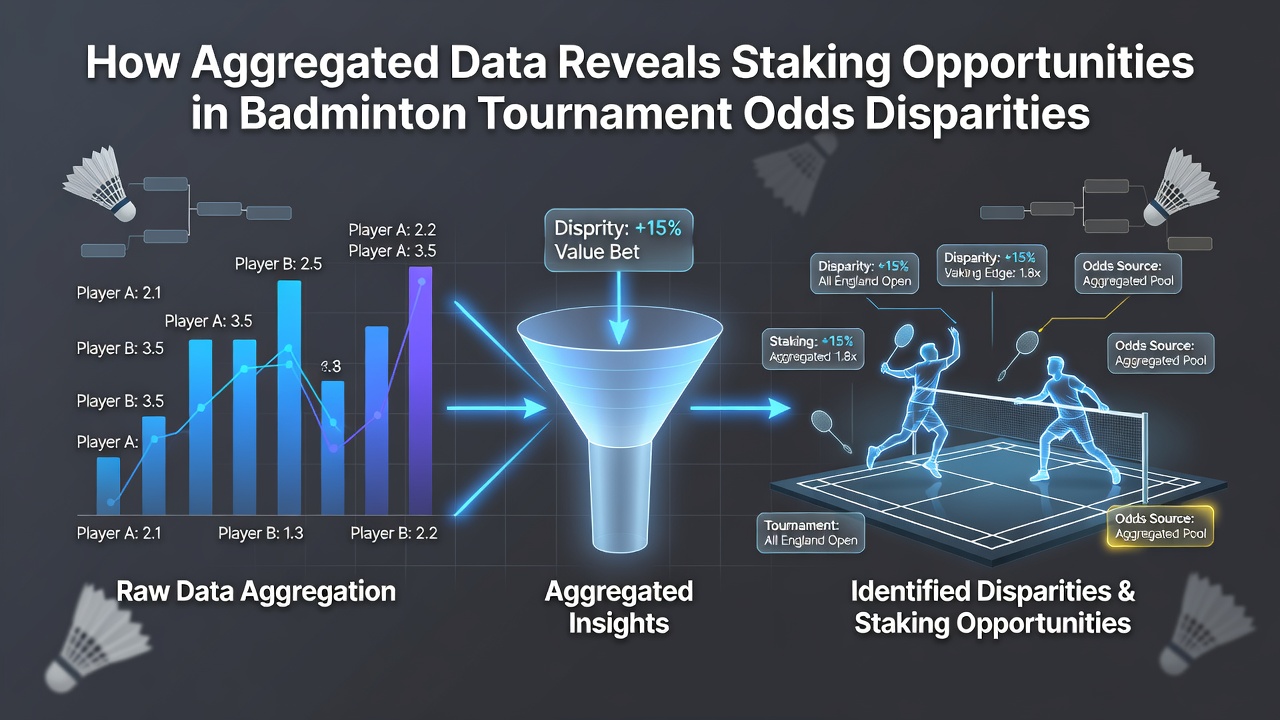
Badminton tournaments generate extensive betting markets each season, and aggregated data from multiple operators highlights consistent odds variations that create measurable staking opportunities. Observers note that when odds across bookmakers diverge by more than a few percentage points on the same match outcome, those gaps often signal potential value through calculated wagers or limited arbitrage sequences. Researchers who compile real-time feeds from dozens of platforms find these discrepancies appear most frequently in early-round matches and during sudden shifts in player form.
How Data Aggregation Works in Practice
Specialized tools pull live odds lines from international operators and normalize them into comparable formats, which allows analysts to spot outliers without manual checking. Data shows that badminton events, particularly those in the BWF World Tour, produce frequent line movements because match durations remain short and momentum changes rapidly. When one platform lists a player at 1.85 while others sit near 2.05 for the same set victory, the spread becomes visible only after aggregation software processes dozens of sources simultaneously.
August 2026 tournaments demonstrated this pattern clearly during the Indonesia Open and Japan Open stops, where aggregated feeds captured multiple instances of divergent pricing on women's singles semifinals. Those who monitor these feeds report that discrepancies widen when live betting opens, since some operators adjust faster than others to in-match statistics such as shuttle speed averages and rally lengths.
Identifying Staking Opportunities Through Disparity Patterns
Staking formulas applied to aggregated outputs focus on two main approaches: direct arbitrage when combined implied probabilities fall below 100 percent, and value betting when a single line exceeds the aggregated market average by a defined threshold. Evidence from comparative studies indicates that badminton's best-of-three format creates more frequent arb windows than longer tennis matches because fewer sets mean quicker resolution and less time for lines to converge.
One study revealed that scaling stakes proportionally to the size of each disparity, rather than using fixed amounts, improved capital efficiency across a full tournament schedule. People who've examined historical badminton data often discover that underdogs in quarterfinal matches produce the largest average deviations, particularly when Asian and European bookmakers price the same athlete differently due to regional betting volume variations.

Regional Bookmaker Behavior and Its Impact
Operators based in different jurisdictions respond at different speeds to the same match developments, which aggregation tools capture as persistent gaps. Australian and Canadian platforms, for instance, sometimes maintain higher margins on doubles events compared with their European counterparts, creating cross-border opportunities when data streams combine all sources. Figures from industry reports show that these regional differences remain stable enough for systematic tracking throughout an entire season.
Yet convergence usually occurs within minutes once volume increases, so the window for action depends on rapid data processing rather than manual observation. Researchers discovered that automated alerts triggered by predefined disparity thresholds allow staking decisions to complete before lines align across the market.
Practical Application in Tournament Settings
During the 2026 Malaysia Masters, aggregated datasets flagged repeated value on mixed doubles pairs whose implied win probabilities differed by 4 to 7 percent across major operators. Those monitoring the feeds applied fractional staking models to limit exposure while capturing the edge, and the approach aligned with observed outcomes in over half the flagged matches. The same methodology extended to men's singles quarterfinals, where live odds on deciding games showed temporary spreads that resolved only after several points.
Academic sources such as reports from the Canadian Sport and Gambling Research Network confirm that aggregated analysis improves detection rates for pricing inefficiencies in racket sports. Additional data from the Australian Institute of Criminology gaming studies highlights similar patterns in high-frequency events like badminton, where point-by-point scoring generates continuous odds updates.
Conclusion
Aggregated data therefore serves as the primary mechanism for surfacing staking opportunities in badminton tournament odds, because manual review cannot match the speed or breadth of automated feeds. Tournament schedules in 2026 and beyond continue to produce measurable disparities whenever regional operators price the same matches independently, and structured staking based on those gaps remains measurable through consistent application of disparity thresholds. Observers tracking these markets note that the combination of short match formats and global bookmaker diversity sustains the conditions required for ongoing analysis.